PTO Shaft for Round Balers
Telescoping PTO drive shafts engineered for the unique load profile of variable-chamber and fixed-chamber round balers. High flywheel inertia, slug feeding, and coast-down back-drive events demand a driveline with overrunning clutch protection, calibrated friction clutch slip, and wide-angle joint geometry — all standard on our round baler PTO shaft range.
Product Overview
What Is a PTO Shaft
for Square Balers?
A PTO shaft for round balers is a telescoping mechanical driveline that connects a tractor’s Power Take-Off output to the input gearbox of a variable-chamber or fixed-chamber round baler. It transmits rotational power at 540 or 1000 RPM to drive the baler’s pickup reel, compression rollers or belts, and the bale-ejection mechanism — all of which must operate simultaneously at consistent speed to produce tightly formed, uniform round bales.
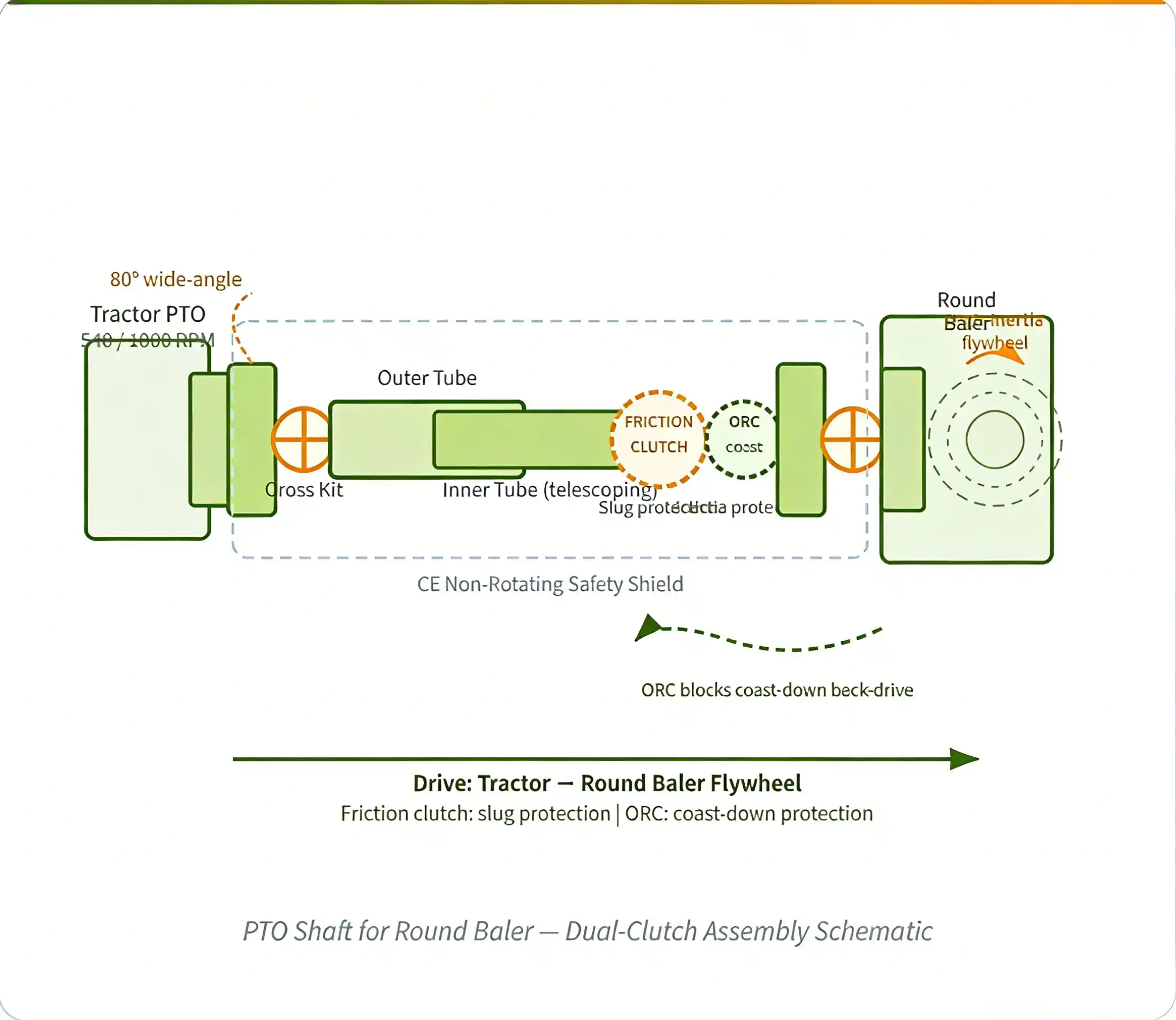
Round balers present a distinctive driveline challenge that sets them apart from square balers and most other implements: high flywheel inertia combined with frequent PTO engagement and disengagement cycles. When the operator disengages the PTO at a headland — standard practice during tight turns on modern operations — the baler’s heavy flywheel continues spinning at full speed for several seconds. Without an overrunning clutch, this rotational inertia back-drives the tractor’s PTO gearbox in reverse, creating a damaging reverse-torque event that can cost $2,500–$7,000 in gearbox repairs.
driveshaftjoint.com supplies round baler PTO shafts in G, S, and L series configurations, covering 15 kW to 107 kW at 540 RPM with peak torque up to 2,500 Nm. Critically, our round baler shafts are available with overrunning clutch (ORC), friction clutch (FC), or combination ORC+FC configurations — the correct choice depends on your baler model and operating pattern.
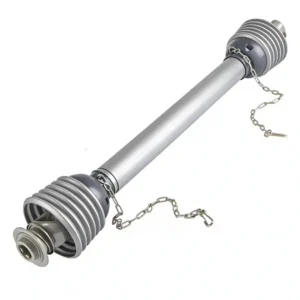
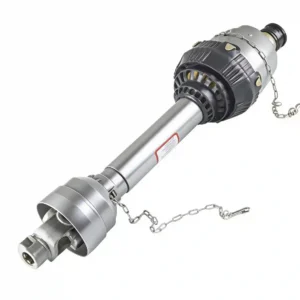
PTO Shaft for Round Balers Disply
Load Profile
Why Round Balers Need a Different
PTO Shaft Specification
Round balers impose three distinct mechanical events on the driveline — each requiring a different protective mechanism. A single-clutch standard PTO shaft addresses only one of them.
Event 1: Slug Feeding
When a large crop slug enters the pickup — a mat of wet alfalfa, a dense grass clump, or an uneven windrow — the baler’s rollers and belts experience a sudden resistance spike. Torque demand can jump to 2–4× continuous load within one second.
Protection Required
Friction Clutch (FC) — slips at rated threshold when slug torque is exceeded, protecting the baler input gearbox and tractor.
Event 2: Flywheel Coast-Down
Modern round balers carry a heavy flywheel that stores rotational energy. When the operator disengages the PTO at a headland turn, the flywheel continues spinning at field speed for 3–8 seconds. This residual inertia drives torque backwards through the PTO shaft into the tractor gearbox.
Protection Required
Overrunning Clutch (ORC) — allows the shaft to spin faster than the tractor PTO stub when disengaged, blocking reverse torque from reaching the gearbox.
Event 3: Bale Ejection Load
As a completed bale is ejected from the chamber, the tail gate opens against the tension of the compressed bale, creating a brief but sharp resistance peak. On net-wrap balers, the wrap cycle itself generates a secondary torque pulse as the cutter engages the wrapping mechanism.
Protection Required
Friction Clutch (FC) — absorbs ejection and wrap-cutter torque pulses before they transfer to the tractor drivetrain.
Mechanics
How a Round Baler PTO Shaft Works
Four simultaneous mechanical functions keep the baler running through every field condition. A failure in any one of them stops the baler — and potentially damages the tractor.
Flywheel & Pickup Drive
The PTO shaft spins the round baler’s flywheel at 540 or 1000 RPM, which in turn drives the pickup reel, crop feeding fingers, and compression belts or rollers. Consistent shaft speed is essential — flywheel speed directly controls bale density and formation rate.
Slug Load Absorption
The friction clutch element slips when crop slug entry or bale ejection causes torque demand to exceed the calibrated threshold. This prevents the input gearbox and tractor PTO components from experiencing the full impact of each slug event during heavy or wet crop baling.
Coast-Down Isolation
The overrunning clutch (ORC) element allows the baler-side of the shaft to spin faster than the tractor PTO stub after disengagement. As the flywheel coasts down from 540–1000 RPM to zero over 3–8 seconds, the ORC freewheels — isolating the gearbox from reverse torque completely.
Telescoping Length Control
As the tractor makes headland turns, the distance between PTO stub and baler input shaft changes. The telescoping inner/outer tube compensates for this without transmitting axial force to the baler’s input shaft bearings — a common cause of premature bearing failure when fixed-length shafts are used.
Common Questions —Feed Mixer PTO Shafts
Why does my round baler PTO shaft vibrate at certain speeds?
Vibration in a round baler PTO shaft is almost always caused by one of four issues.
- (1) Shaft angle exceeds joint rating: if your tractor-to-baler angle exceeds 35–45° and you are using a standard joint, the cross kit generates cyclical speed variation (Cardan error) that manifests as vibration at specific RPMs. Switch to a wide-angle joint (80°) to eliminate this.
- (2) Tube imbalance after bending: if the outer tube has been bent by ground contact and is no longer straight, the shaft will be dynamically unbalanced. Replace the damaged tube.
- (3) Cross kit wear: a worn or pitted cross kit bearing allows angular play in the joint, creating vibration at operating speed. Replace the cross kit.
- (4) Incorrect shaft length: a shaft that is too long for the application may sag at mid-span and vibrate at or near its resonant frequency.
Measure and confirm your correct shaft length and tube profile against the power table.
What PTO series is right for my 80 hp round baler tractor?
An 80 hp tractor has a PTO output of approximately 55–70 kW depending on powertrain efficiency (use PTO hp, not engine hp). This maps directly to G7 (55 kW / 75 hp at 540 RPM, 1,800 Nm peak) for standard grass hay in dry conditions. For wet or heavy crop conditions — which increase slug torque substantially — specify S7 or S8 (55–70 kW, 1,800–2,250 Nm peak). The S series star profile also provides better fatigue resistance for high-volume operations where the baler runs 8–12 hours per day at peak season. Always specify ORC+FC for an 80 hp application to cover both coast-down protection and slug feeding events.
Should I choose ORC only, FC only, or ORC+FC for my round baler?
The correct choice depends on your baler model and crop conditions. ORC only: suitable for round balers in light, dry conditions where slug events are rare and the main risk is coast-down back-drive. The ORC protects the gearbox from flywheel inertia but does not slip under forward overload. FC only: protects against slug feeding and ejection overload but leaves the gearbox unprotected from coast-down events. Only appropriate if the operator never disengages the PTO while the flywheel is spinning — not practical in normal operation. ORC+FC combination: recommended for most round baler applications. The FC protects against forward overload from slug feeding; the ORC protects against reverse torque from flywheel coast-down. This combination addresses all three load events described on this page. If you are unsure, contact us with your baler make and model and we will specify the correct configuration.
What is an overrunning clutch and why is it essential for round balers?
An overrunning clutch (ORC) is a one-way mechanical clutch that allows the implement side of the PTO shaft to rotate faster than the tractor side. In the drive direction (tractor driving the baler), it locks and transmits torque normally. When the PTO is disengaged, the baler’s flywheel continues spinning at field speed — in some cases at 540+ RPM — for 3–8 seconds. Without an ORC, this flywheel inertia transmits reverse torque back through the PTO shaft and into the tractor’s gearbox, causing internal gear impacts and progressive bearing damage. A friction clutch alone does not protect against this — it only slips when forward torque exceeds the threshold.
An ORC is the only effective protection against coast-down back-drive. For round balers, where the operator disengages and re-engages the PTO at every headland, the ORC experiences hundreds of protection events per working day.