Product Description
ABS Ring Included: No
Axle Nut Locking Type: Self Lock
Axle Nut Supplied: Yes
Compressed Length: 21 1/4″
CV Axles Inboard Spline Count: 26
Emission Code : 1
Inboard Joint Type: Female
Input Shaft Connection Style: Spline
Input Shaft Spline Count: 26
Interchange Part Number: , GM-8047, 179047, GM-6120, GM6120, 9456N
Label Description – 80: New Constant Velocity Drive Axle
Length Measurement Method: Compressed
Life Cycle Status Code: 2
Life Cycle Status Description: Available to Order
Maximum Cases per Pallet Layer: 10
MSDS Required Flag: N
National Popularity Code : B
National Popularity Description: Next 20% of Product Group Sales Value
New or Remanufactured: New
Nut Head Size: 36mm Hex Head
Nut Length: OAH 20.8mm
Nut Locking Type: Self Lock
Nut Thread Size: M24 x 2.0
Other Part Number: 815-5270, GM-8232, 80-1507, , 80571
Outboard Joint Type: Male
Outboard Spline Count: 27
Output Shaft Connection Style: Spline
Output Shaft Spline Count: 27
Overall Length: 21 1/4″
Pallet Layer Maximum: 6
Product Condition: New
Product Description – Invoice – 40: CV Drive Axle New
Product Description – Long – 80: CV Drive Axle – Domestic New
Product Description – Short – 20: CV Drive Axle
Remanufactured Part: N
Spindle Nut Hex Head Size: 36mm
Spindle Nut Included: Yes
Spindle Nut Thread Size: M24 x 2.0
Drive Shaft | PATRON : PDS1507
- Fitting Position: Front Axle Right
REF NO.
FactoryNumber
GSP208050
OE Number
MakeNumber
GMC93720063
MakeNumber
GMC
MakeNumber
ISUZU
| After-sales Service: | Available |
|---|---|
| Condition: | New |
| Certification: | DIN, ISO, ISO, DIN |
| Type: | C.V. Joint |
| Application Brand: | GM |
| Material: | Steel |
| Samples: | US$ 30/Piece 1 Piece(Min.Order) | |
|---|
| Customization: | Available | Customized Request |
|---|
How do you calculate the torque capacity of a universal joint?
Calculating the torque capacity of a universal joint involves considering various factors such as the joint’s design, material properties, and operating conditions. Here’s a detailed explanation:
The torque capacity of a universal joint is determined by several key parameters:
- Maximum Allowable Angle: The maximum allowable angle, often referred to as the “operating angle,” is the maximum angle at which the universal joint can operate without compromising its performance and integrity. It is typically specified by the manufacturer and depends on the joint’s design and construction.
- Design Factor: The design factor accounts for safety margins and variations in load conditions. It is a dimensionless factor typically ranging from 1.5 to 2.0, and it is multiplied by the calculated torque to ensure the joint can handle occasional peak loads or unexpected variations.
- Material Properties: The material properties of the universal joint’s components, such as the yokes, cross, and bearings, play a crucial role in determining its torque capacity. Factors such as the yield strength, ultimate tensile strength, and fatigue strength of the materials are considered in the calculations.
- Equivalent Torque: The equivalent torque is the torque value that represents the combined effect of the applied torque and the misalignment angle. It is calculated by multiplying the applied torque by a factor that accounts for the misalignment angle and the joint’s design characteristics. This factor is often provided in manufacturer specifications or can be determined through empirical testing.
- Torque Calculation: To calculate the torque capacity of a universal joint, the following formula can be used:
Torque Capacity = (Equivalent Torque × Design Factor) / Safety Factor
The safety factor is an additional multiplier applied to ensure a conservative and reliable design. The value of the safety factor depends on the specific application and industry standards but is typically in the range of 1.5 to 2.0.
It is important to note that calculating the torque capacity of a universal joint involves complex engineering considerations, and it is recommended to consult manufacturer specifications, guidelines, or engineering experts with experience in universal joint design for accurate and reliable calculations.
In summary, the torque capacity of a universal joint is calculated by considering the maximum allowable angle, applying a design factor, accounting for material properties, determining the equivalent torque, and applying a safety factor. Proper torque capacity calculations ensure that the universal joint can reliably handle the expected loads and misalignments in its intended application.
What is the lifespan of a typical universal joint?
The lifespan of a typical universal joint can vary depending on several factors. Here’s a detailed explanation:
The lifespan of a universal joint depends on various factors, including the quality of the joint, operating conditions, maintenance practices, and the specific application. While it is challenging to provide an exact lifespan, considering the following factors can help estimate the longevity of a universal joint:
- Quality and Materials: The quality of the universal joint and the materials used in its construction play a significant role in determining its lifespan. High-quality joints made from durable materials, such as alloy steels or stainless steels, tend to have longer lifespans compared to lower-quality or less robust joints made from inferior materials.
- Operating Conditions: The operating conditions in which the universal joint is used can significantly impact its lifespan. Factors such as torque levels, rotational speed, angular misalignment, vibration, temperature, and exposure to contaminants can all affect the joint’s performance and longevity. Operating the joint within its specified limits, avoiding excessive or extreme conditions, and providing proper maintenance can help extend its lifespan.
- Maintenance Practices: Regular maintenance is essential for maximizing the lifespan of a universal joint. Proper lubrication, periodic inspection for wear or damage, and timely replacement of worn components can help prevent premature failure. Adhering to the manufacturer’s recommended maintenance schedule and guidelines is crucial to ensure optimal performance and longevity.
- Application Requirements: The specific application requirements and demands placed on the universal joint influence its lifespan. Heavy-duty applications with high torque, frequent load fluctuations, or extreme operating conditions may result in increased stress and wear on the joint, potentially shortening its lifespan. Selecting a universal joint that is specifically designed and rated for the application’s requirements can help ensure a longer lifespan.
Given these factors, it is challenging to provide a precise lifespan for a typical universal joint. In some applications with proper maintenance and suitable operating conditions, a universal joint can last for several years. However, in demanding or harsh operating environments, or if subjected to excessive loads or misalignment, the lifespan of the joint may be shorter, requiring more frequent replacements.
It’s important to consult the manufacturer’s guidelines and recommendations for the specific universal joint being used, as they can provide more accurate information regarding its expected lifespan under different operating conditions. Additionally, monitoring the joint’s performance, conducting regular inspections, and addressing any signs of wear or deterioration can help identify the need for replacement and ensure safe and reliable operation.
What is a universal joint and how does it work?
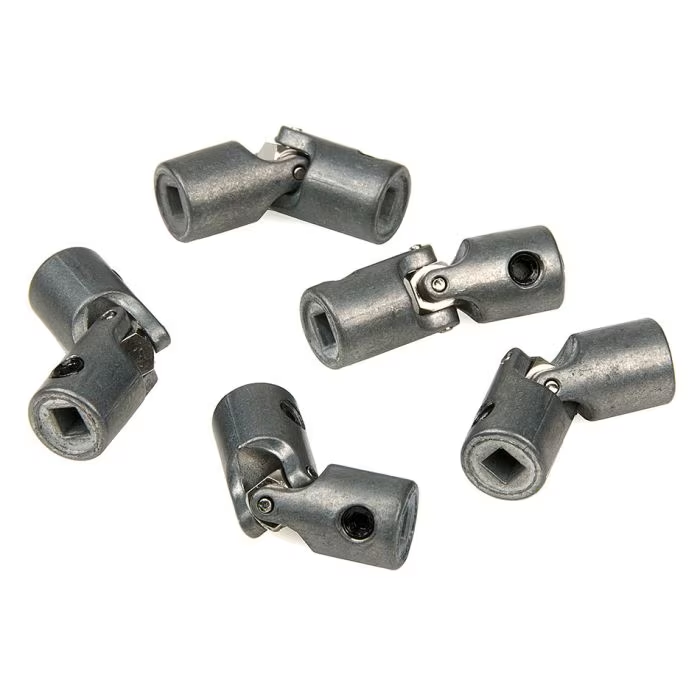
A universal joint, also known as a U-joint, is a mechanical coupling that allows for the transmission of rotary motion between two shafts that are not in line with each other. It is commonly used in applications where shafts need to transmit motion at angles or around obstacles. The universal joint consists of a cross-shaped or H-shaped yoke with bearings at the ends of each arm. Let’s explore how it works:
A universal joint typically comprises four main components:
- Input Shaft: The input shaft is the shaft that provides the initial rotary motion.
- Output Shaft: The output shaft is the shaft that receives the rotary motion from the input shaft.
- Yoke: The yoke is a cross-shaped or H-shaped component that connects the input and output shafts. It consists of two arms perpendicular to each other.
- Bearings: Bearings are located at the ends of each arm of the yoke. These bearings allow for smooth rotation and reduce friction between the yoke and the shafts.
When the input shaft rotates, it causes the yoke to rotate along with it. Due to the perpendicular arrangement of the arms, the output shaft connected to the other arm of the yoke experiences rotary motion at an angle to the input shaft.
The universal joint works by accommodating the misalignment between the input and output shafts. As the input shaft rotates, the yoke allows the output shaft to rotate freely and continuously despite any angular displacement or misalignment between the two shafts. This flexibility of the universal joint enables torque to be transmitted smoothly between the shafts while compensating for their misalignment.
During operation, the bearings at the ends of the yoke arms allow for the rotation of the yoke and the connected shafts. The bearings are often enclosed within a housing or cross-shaped cap to provide protection and retain lubrication. The design of the bearings allows for a range of motion and flexibility, allowing the yoke to move and adjust as the shafts rotate at different angles.
The universal joint is commonly used in various applications, including automotive drivelines, industrial machinery, and power transmission systems. It allows for the transmission of rotary motion at different angles and helps compensate for misalignment, eliminating the need for perfectly aligned shafts.
It is important to note that universal joints have certain limitations. They introduce a small amount of backlash or play, which can affect precision and accuracy in some applications. Furthermore, at extreme angles, the operating angles of the universal joint may become limited, potentially causing increased wear and reducing its lifespan.
Overall, the universal joint is a versatile mechanical coupling that enables the transmission of rotary motion between misaligned shafts. Its ability to accommodate angular displacement and misalignment makes it a valuable component in numerous mechanical systems.


editor by CX 2023-11-20