Overview of Universal Driveshafts in Pulp & Paper Operations
In Australian pulp and paper mills, universal driveshafts—often Cardan types with double yokes—connect prime movers to driven equipment where perfect alignment is impossible due to thermal expansion, foundation settling, or vibration. Typical specs include shaft diameters from 50 mm to 150 mm, torque capacities up to 50,000 Nm, and operating angles up to 15° continuous (25° intermittent). Shock loads can reach 200% of nominal torque during startups or jams, exacerbated by 24/7 runs in humidities exceeding 80% RH.
Misalignment tolerances are tight: angular up to 3° per joint, parallel offset 2 mm/m of length. Exceeding these leads to accelerated wear. Bearing life is calculated via ISO 281: L10 = (C/P)^3 * 10^6 revolutions, where C is dynamic load rating (e.g., 50 kN for a 100 mm shaft) and P is equivalent load incorporating torque and angle factors. In humid mills, corrosion protection via 316 stainless steel or epoxy coatings extends life from 5,000 to 10,000 hours.
Applications in Chippers and Debarkers
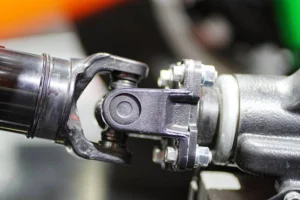
Chippers and debarkers process raw logs into uniform chips, subjecting driveshafts to high-impact loads from uneven wood density. In a typical Australian eucalypt mill, driveshafts transmit 10,000–20,000 Nm torque from electric motors (up to 500 kW) to rotating knives, operating at 1,500 rpm with shock peaks at 150% due to log jams.
Failure modes include yoke fatigue from cyclic loading and spider bearing seizure in humid, chip-laden air. Alignment errors of 2° can reduce bearing life by 50%, per the formula: Life reduction factor = 1 / (1 + 0.5 * sin(θ)^2), where θ is misalignment angle. Lubrication strategy: sealed-for-life units with synthetic grease (NLGI 2, molybdenum disulphide additive) checked every 500 hours, vital in remote sites where downtime costs $10,000/hour.
| Parameter | Value | Notes |
|---|---|---|
| Torque Range | 10,000–20,000 Nm | Nominal at 1,500 rpm |
| Shaft Diameter | 80–120 mm | Carbon steel with spline ends |
| Operating Angle | Up to 10° | Continuous in humid conditions |
| Maintenance Interval | 500 hours | Grease check; extend with seals |
Applications in Pulp Refiners
Pulp refiners use conical or disc designs to fibrillate fibres, with driveshafts linking motors (300–1,000 kW) to refiner plates. Torque demands hit 30,000 Nm under load, with 100% shock from pulp slugs. In Australia’s high-humidity mills (e.g., 90% RH in Queensland), sealing designs incorporate double-lip Viton seals to prevent water ingress, maintaining IP65 ratings.
Corrosion is rampant; uncoated shafts fail in 2 years via pitting, but galvanised or stainless variants last 5+ years. Remote maintenance challenges mean predictive vibration monitoring (ISO 10816 limits: 4.5 mm/s RMS) flags issues early. Formula for power transmission: P = (T * ω) / 1000 kW, where ω = 2πn/60 rad/s, ensuring no resonance at critical speeds.
Applications in Vacuum Pumps
Vacuum pumps in dewatering sections rely on driveshafts for torque transfer from drives to impellers, handling 5,000–15,000 Nm at 1,000 rpm. Operating angles reach 8° due to pump misalignment from thermal growth in steam-heavy environments.
Failure from cavitation-induced shocks (up to 180% overload) causes spider wear; life calc: L10h = (10^6 / (60n)) * (C/P)^3 hours, targeting 20,000 hours. Lubrication: oil-mist systems in humid areas, with ISO VG 68 oil changed every 1,000 hours to combat moisture emulsification.
Applications in Press Section
Press sections squeeze water from pulp webs, with driveshafts syncing rolls at torques of 15,000–40,000 Nm. Continuous 24/7 ops in 85% RH amplify alignment issues; tolerances: 1 mm parallel offset max.
Sealing against felt debris uses labyrinth designs with purge air. Corrosion protection: chromate conversion coatings resist acidic liquors (pH 4–6). Maintenance: laser alignment checks quarterly, reducing vibration by 30% and extending bearing life.
| Mode | Cause | Mitigation |
|---|---|---|
| Yoke Fracture | Shock Loads >150% | Torque Limiters |
| Bearing Seizure | Humidity Ingress | Viton Seals |
| Corrosion Pitting | Acidic Environment | Stainless Overlays |
Applications in Drying Cylinders
Drying cylinders evaporate moisture via steam-heated rolls, driveshafts conveying 20,000–50,000 Nm torque across multiple sections. Angles up to 12° accommodate expansion; shocks from web breaks hit 200%.
In remote Australian mills, lubrication uses automatic greasers (e.g., 50 g/month) to avoid shutdowns. Bearing life: Adjust P for angle via P_eq = P_rad + (T * sin(θ) / r), ensuring >15,000 hours.
Applications in Rewinder and Cutter
Rewinders and cutters handle finished paper rolls, with driveshafts at 10,000–30,000 Nm for precise speed control. Misalignment from roll buildup: 2° max to prevent web wander.
Failure modes: spline wear in humid air; strategy: dry-film lubricants for 2,000-hour intervals. Corrosion: epoxy paints for coastal mills, resisting salt-laden humidity.
General Engineering Considerations for Australian Conditions
Australia’s pulp mills face unique challenges: high humidity accelerates oxidation, 24/7 ops demand 95% uptime, and remote locations limit on-site expertise. Driveshafts must incorporate IP67 seals, with maintenance intervals extended via condition monitoring (vibration thresholds: 7.1 mm/s alarm).
For inquiries on custom driveshaft solutions tailored to your mill’s specs, contact us at AU driveshaftjoint.com Co.,Ltd, 27 Harley Crescent, Condell Park NSW 2200, Sydney, Australia. Email: [email protected].