Product Description
| Product Description |
| Warranty | 1 Year | Certification | TS16949 |
| Color | Natural color | Application | Massey Ferguson |
| OEM NO. | 1277261C1 | MOQ | 100 PCS |
| Engravement | Customized | Port | HangZhou/ZheJiang |
Specifications
1.Supply to USA,Europe,and so on
2.Matrial:Body C45 Ball Pin Cr40
3.Professional Perfomance Auto parts supplier
| Detail Images |
| Other Products |
| Our Company |
| Packing & Delivery |
| Certification |
| Our Service |
1. OEM Manufacturing welcome: Product, Package…
2. Sample order
3. We will reply you for your inquiry in 24 hours.
4. after sending, we will track the products for you once every 2 days, until you get the products. When you got the
goods, test them, and give me a feedback.If you have any questions about the problem, contact with us, we will offer
the solve way for you.
| FAQ |
Q1. What is your terms of packing?
A: Generally, we pack our goods in neutral white boxes and brown cartons. If you have legally registered patent,
we can pack the goods in your branded boxes after getting your authorization letters.
Q2. What is your terms of payment?
A: T/T 30% as deposit, and 70% before delivery. We’ll show you the photos of the products and packages
before you pay the balance.
Q3. What is your terms of delivery?
A: EXW, FOB, CFR, CIF, DDU.
Q4. How about your delivery time?
A: Generally, it will take 30 to 60 days after receiving your advance payment. The specific delivery time depends
on the items and the quantity of your order.
Q5. Can you produce according to the samples?
A: Yes, we can produce by your samples or technical drawings. We can build the molds and fixtures.
Q6. What is your sample policy?
A: We can supply the sample if we have ready parts in stock, but the customers have to pay the sample cost and
the courier cost.
Q7. Do you test all your goods before delivery?
A: Yes, we have 100% test before delivery
Q8: How do you make our business long-term and good relationship?
A:1. We keep good quality and competitive price to ensure our customers benefit ;
2. We respect every customer as our friend and we sincerely do business and make friends with them,
no matter where they come from.
| After-sales Service: | Help Check |
|---|---|
| Warranty: | 1 Year |
| Type: | Ball Joint |
| Material: | Stainless Steel |
| Certification: | ISO, AISI, DIN, API, CE, ASTM |
| Automatic: | Automatic |
| Samples: | US$ 15/Piece 1 Piece(Min.Order) | |
|---|
| Customization: | Available | Customized Request |
|---|
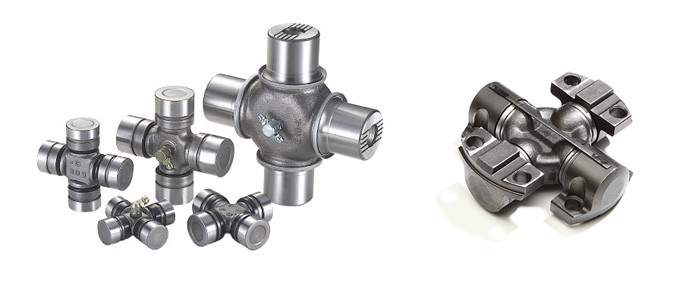
How do you retrofit an existing mechanical system with a universal joint?
Retrofitting an existing mechanical system with a universal joint involves modifying or adding components to integrate the universal joint into the system. Here’s a detailed explanation of the retrofitting process:
To retrofit an existing mechanical system with a universal joint, follow these steps:
- Evaluate the System: Begin by thoroughly assessing the existing mechanical system. Understand its design, components, and the type of motion it requires. Identify the specific area where the universal joint needs to be incorporated and determine the necessary modifications or additions.
- Design Considerations: Take into account the operating conditions, load requirements, and available space in the system. Consider the size, type, and specifications of the universal joint that will best suit the retrofit. This includes selecting the appropriate joint size, torque capacity, operating angles, and any additional features required for compatibility with the system.
- Measurements and Alignment: Accurately measure the dimensions and alignment of the existing system, particularly the shafts involved in the retrofit. Ensure that the required modifications or additions align properly with the system’s existing components. Precise measurements are crucial for a successful retrofit.
- Modify Existing Components: In some cases, it may be necessary to modify certain components of the existing system to accommodate the universal joint. This could involve machining or welding to create attachment points or adjust the dimensions of the system’s components to ensure proper fitment of the universal joint and its associated parts.
- Integrate the Universal Joint: Install the universal joint into the retrofit area according to the system’s requirements and design considerations. This involves securely attaching the universal joint to the modified or existing components using appropriate fasteners or connection methods as specified by the manufacturer. Ensure that the joint is properly aligned with the shafts to facilitate smooth and efficient motion transfer.
- Supporting Components: Depending on the specific retrofit requirements, additional supporting components may be needed. This can include yokes, bearings, shaft couplings, or guards to ensure proper functioning and protection of the universal joint assembly and the overall system.
- Testing and Adjustment: Once the retrofit is complete, thoroughly test the system to ensure that the universal joint operates smoothly and meets the desired performance requirements. Make any necessary adjustments to align the system and optimize its functionality. It is essential to verify that the retrofit does not introduce any adverse effects or compromise the overall operation of the mechanical system.
Retrofitting an existing mechanical system with a universal joint requires careful planning, precise measurements, and proper integration of the joint into the system. By following these steps and considering the design considerations and compatibility, it is possible to successfully incorporate a universal joint into an existing mechanical system and enhance its functionality and performance.
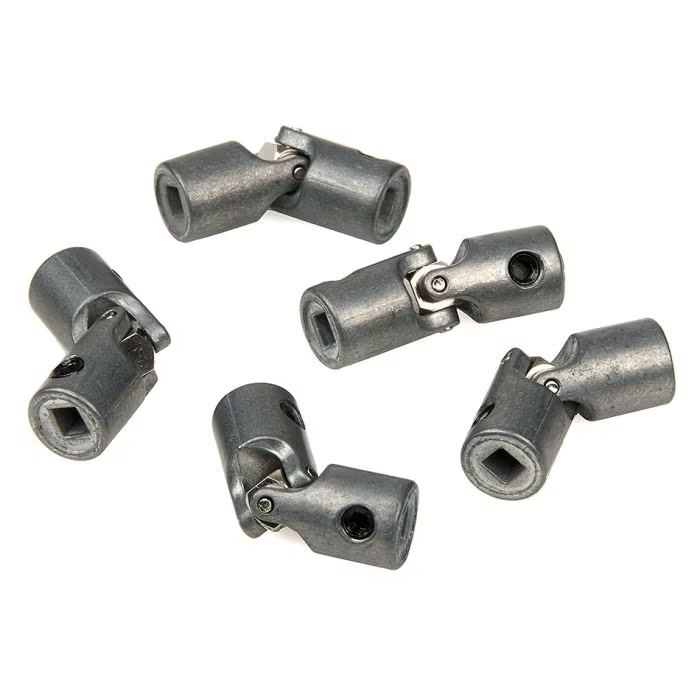
What materials are commonly used in the construction of universal joints?
Universal joints are constructed using various materials that provide strength, durability, and resistance to wear and fatigue. Here’s a detailed explanation:
The choice of materials for universal joints depends on factors such as the application, load requirements, operating conditions, and cost considerations. Here are some commonly used materials:
- Steel: Steel is one of the most common materials used in universal joint construction. Alloy steels, such as 4140 or 4340, are often employed due to their high strength, toughness, and resistance to wear and fatigue. Steel universal joints can withstand heavy loads and harsh operating conditions, making them suitable for various industrial applications.
- Stainless Steel: Stainless steel is chosen for universal joints when corrosion resistance is a critical requirement. Stainless steel alloys, such as 304 or 316, offer excellent resistance to rust, oxidation, and chemical corrosion. These joints are commonly used in applications where exposure to moisture, chemicals, or harsh environments is expected.
- Cast Iron: Cast iron is occasionally used in universal joints, particularly in older or specialized applications. Cast iron provides good strength and wear resistance, but it is generally heavier and less flexible than steel. It may be used in specific situations where its properties are advantageous, such as in large industrial machinery.
- Aluminum: Aluminum universal joints are utilized when weight reduction is a priority. Aluminum alloys offer a good balance of strength and lightweight properties. These joints are commonly found in applications where weight savings are crucial, such as aerospace, automotive, or robotics.
- Bronze: Bronze is sometimes used for bearings or bushings within universal joints. Bronze alloys provide good wear resistance, low friction, and the ability to withstand high temperatures. They are often employed in applications where self-lubricating properties and resistance to galling are required. Bronze bearings can be found in universal joints used in heavy machinery, marine equipment, or agricultural machinery.
It’s worth noting that the specific choice of materials may vary depending on the manufacturer, application requirements, and industry standards. Different combinations of materials may also be used for different components within a universal joint, such as the yokes, crosses, bearings, or seals, to optimize performance and durability.
In summary, universal joints are commonly constructed using materials such as steel, stainless steel, cast iron, aluminum, and bronze. The selection of materials depends on factors like strength, durability, wear resistance, corrosion resistance, weight considerations, and specific application requirements.
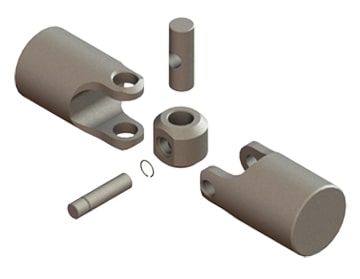
What are the applications of a universal joint?
A universal joint, also known as a U-joint, finds applications in various industries and mechanical systems where the transmission of rotary motion is required between misaligned shafts. Here are some common applications of universal joints:
- Automotive Drivelines: One of the most well-known applications of universal joints is in automotive drivelines. Universal joints are used in the drivetrain to transmit power from the engine to the wheels while accommodating the misalignment between the engine, transmission, and axle shafts. They are commonly found in rear-wheel drive and four-wheel drive vehicles, connecting the transmission output shaft to the drive shaft and allowing the wheels to receive power even when the suspension system causes changes in angles and positions.
- Industrial Machinery: Universal joints are widely used in industrial machinery where the transmission of motion at angles is required. They are employed in various types of machinery, such as conveyors, mixers, pumps, printing presses, and machine tools. Universal joints enable the transfer of rotary motion between misaligned shafts, allowing these machines to operate efficiently and effectively.
- Marine and Propulsion Systems: In marine applications, universal joints are used in propulsion systems to transmit power from the engine to the propeller shaft. They allow for the necessary flexibility to accommodate the movement of the vessel and changes in the propeller shaft angle. Universal joints are also used in marine steering systems to transfer motion between the steering wheel and the rudder or outboard motor.
- Agricultural Equipment: Universal joints are utilized in agricultural machinery and equipment such as tractors, combines, and harvesters. They enable the transmission of power between different components, such as the engine, gearbox, and wheels, even when these components are not perfectly aligned. Universal joints provide the necessary flexibility to accommodate the movement and articulation required in agricultural operations.
- Aerospace and Aviation: Universal joints are used in aerospace and aviation applications where motion transmission at angles is required. They can be found in control systems for aircraft wings, flaps, and landing gear. Universal joints allow for the transfer of motion and control inputs between different components, ensuring smooth and reliable operation.
- Heavy Machinery and Construction Equipment: Universal joints are employed in heavy machinery and construction equipment, such as cranes, excavators, and loaders. They enable the transmission of power and motion between different parts of the machinery, accommodating the misalignment that may arise due to the movement and articulation of these machines.
- Railway Systems: Universal joints are used in railway systems for various applications. They are employed in drivetrains and power transmission systems to transmit motion between different components, such as the engine, gearboxes, and axles. Universal joints allow for smooth power transfer while accommodating the misalignment caused by the suspension and movement of the train.
- Robotics and Automation: Universal joints find applications in robotics and automation systems where motion needs to be transmitted between misaligned components. They are used in robotic arms, manipulators, and other automated systems to enable flexible and precise movement while accommodating misalignment and articulation requirements.
These are just a few examples of the diverse range of applications for universal joints. Their ability to transmit rotary motion between misaligned shafts with flexibility and efficiency makes them an essential component in numerous industries and mechanical systems.


editor by CX 2023-12-12