Product Description
Product Description
Type | Wire Rope Clip |
| Length | 1M or as requirment |
| Diameter | 1.0mm,1.2mm,1.5mm |
| Feature | adjustable |
| Standard | OEM/ODM Drawing |
| Service | OEM Service |
| surface treatment | plating chrome or nickel |
| Application | linear light/pendant light |
Detailed Photos
Our Advantages
We can produce customized and standard metal parts.
The materials include steel, stainless steel, aluminum, brass, plastic, PP, nylon, Titanium, etc
Sandblasting, Anodizing Color, Blackenning, Zinc\Nickl Plating, Polishing And Brushing,Etc.
After Sales Service
All products with mark label.
We take pictures for each order then email to customers.
We track all shipping processes
Any quality problem that we will deal it in the first time as soon as possible.
Company Profile
HangZhou Custom Hardware Technology Co., Ltd
HangZhou Custom Hardware Technology Co., Ltd is mainly engeged in cargo lashing belt series, Precast Concrete Shuttering Magnets,customized precision hardware, stamping parts, powder metallurgy parts, Our products are widely exported to Europe, North America,Australia and other middle and high-end market, our customers in more than 40 countries. Our company is a service innovation company specializing in providing one-stop solutions for customized precision hardware. We comprehensively expand our business in 2018, determined to become a large-scale complex integrating high-quality foreign trade services , product research and development of intelligent manufacturing, and new project development as 1 of the large company. Our sales was more than USD 6,000,000 in 2019.Our technical team has more than 30 top engineers and senior technicians with 20 years of experience in intelligent manufacturing. Our supply chain has the largest and authoritative material supplier in China, as well as the most avant-garde equipment supplier in China, Germany and USA.
Workshop
FAQ
Q1. Are you factory for trade company?
A: We are factory for lashing strap, hardware and rubber product manufacturing.
Q2. What is your terms of payment?
A: T/T 30% as deposit, and 70% balance against BL copy.
Q3. What is your terms of delivery?
A: EXW, FOB, CFR, CIF, DDU.
Q4. How about your delivery time?
A: We can send out the order in 3-30days depend on the quantity.
Q5. Can you produce according to the samples?
A: Yes, we can produce by your samples or technical drawings. We are able to make new mould.
Q6. What is your sample policy?
A: We can supply the sample if we have ready parts in stock, but the customers have to pay the sample cost and
the courier cost.
Q7. Do you test all your goods before delivery?
A: Yes, we have test machine and QC worker to do the test.
Q8: How do you make our business long-term and good relationship?
A:1. We keep good quality and competitive price to ensure our customers benefit ;
2. We respect every customer as our friend and we sincerely do business and make friends with them,
no matter where they come from.
| Material: | Stainless Steel |
|---|---|
| Type: | Wire Rope Clip |
| Shape: | Double Hook |
| Samples: | US$ 1.5/Piece 1 Piece(Min.Order) | Order Sample new |
|---|
| Customization: | Available | Customized Request |
|---|
.shipping-cost-tm .tm-status-off{background: none;padding:0;color: #1470cc}
| Shipping Cost: Estimated freight per unit. | about shipping cost and estimated delivery time. |
|---|
| Payment Method: |
|
|---|---|
| Initial Payment Full Payment |
| Currency: | US$ |
|---|
| Return&refunds: | You can apply for a refund up to 30 days after receipt of the products. |
|---|
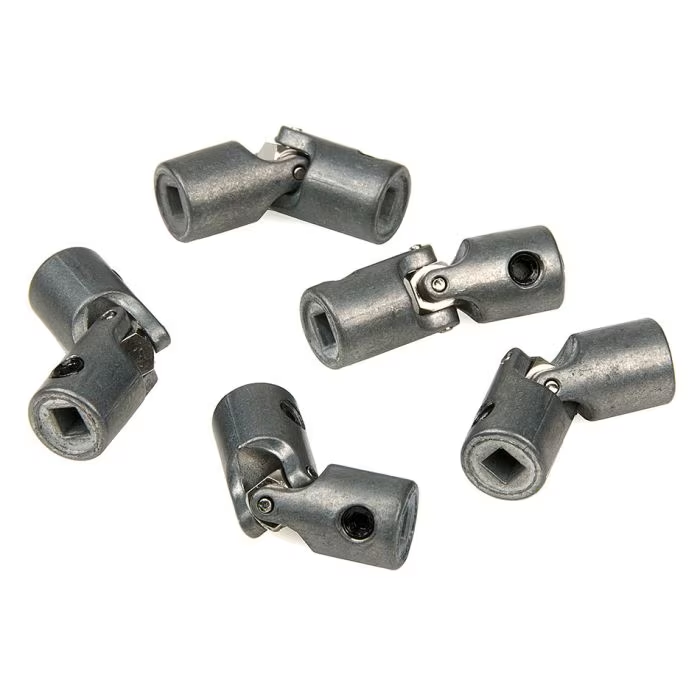
What is the role of needle bearings in a universal joint?
Needle bearings play a critical role in the operation of a universal joint. Here’s a detailed explanation:
A universal joint, also known as a U-joint, is a mechanical coupling that allows the transmission of rotational motion between two misaligned shafts. It consists of a cross-shaped component with needle bearings positioned at each end of the cross.
The role of needle bearings in a universal joint is to facilitate smooth rotation and efficient power transmission while accommodating the misalignment between the shafts. Here are the key functions of needle bearings:
- Reducing Friction: Needle bearings are designed to minimize friction and provide a low-resistance interface between the rotating components of the universal joint. The needle-like rollers in the bearings have a large surface area in contact with the inner and outer raceways, distributing the load evenly. This design reduces frictional losses and ensures efficient power transmission.
- Accommodating Misalignment: Universal joints are often used to transmit motion between shafts that are not perfectly aligned. Needle bearings are capable of accommodating angular misalignment, allowing the shafts to operate at different angles while maintaining smooth rotation. The flexibility of the needle bearings enables the universal joint to compensate for misalignment and transmit torque without excessive stress or wear.
- Supporting Radial Loads: In addition to transmitting torque, needle bearings in a universal joint also provide support for radial loads. Radial loads are forces acting perpendicular to the shaft’s axis, and the needle bearings are designed to handle these loads while maintaining proper alignment and rotation. This capability is particularly important in applications where the universal joint experiences varying loads or vibrations.
- Enhancing Durability: Needle bearings are designed to withstand high-speed rotation, heavy loads, and demanding operating conditions. They are typically made of hardened steel or other durable materials that offer high strength and wear resistance. The robust construction of the needle bearings ensures long-lasting performance and reliability in the universal joint.
- Providing Lubrication: Proper lubrication is crucial for the smooth operation and longevity of needle bearings. Lubricants, such as grease or oil, are applied to the needle bearings to reduce friction, dissipate heat, and prevent premature wear. The lubrication also helps to protect the bearings from contamination and corrosion, especially in marine or harsh environments.
Overall, needle bearings in a universal joint enable efficient power transmission, accommodate misalignment, support radial loads, enhance durability, and require proper lubrication. They are essential components that contribute to the smooth and reliable operation of the universal joint in various applications, including automotive drivelines, industrial machinery, and aerospace systems.
How does a constant-velocity (CV) joint differ from a traditional universal joint?
A constant-velocity (CV) joint differs from a traditional universal joint in several ways. Here’s a detailed explanation:
A traditional universal joint (U-joint) and a constant-velocity (CV) joint are both used for transmitting torque between non-aligned or angularly displaced shafts. However, they have distinct design and operational differences:
- Mechanism: The mechanism of torque transmission differs between a U-joint and a CV joint. In a U-joint, torque is transmitted through a set of intersecting shafts connected by a cross or yoke arrangement. The angular misalignment between the shafts causes variations in speed and velocity, resulting in fluctuating torque output. On the other hand, a CV joint uses a set of interconnected elements, typically ball bearings or roller bearings, to maintain a constant velocity and torque output, regardless of the angular displacement between the input and output shafts.
- Smoothness and Efficiency: CV joints offer smoother torque transmission compared to U-joints. The constant velocity output of a CV joint eliminates speed fluctuations, reducing vibrations and allowing for more precise control and operation. This smoothness is particularly advantageous in applications where precise motion control and uniform power delivery are critical. Additionally, CV joints operate with higher efficiency as they minimize energy losses associated with speed variations and friction.
- Angular Capability: While U-joints are capable of accommodating larger angular misalignments, CV joints have a limited angular capability. U-joints can handle significant angular displacements, making them suitable for applications with extreme misalignment. In contrast, CV joints are designed for smaller angular displacements and are typically used in applications where constant velocity is required, such as automotive drive shafts.
- Operating Angles: CV joints can operate at larger operating angles without significant loss in torque or speed. This makes them well-suited for applications that require larger operating angles, such as front-wheel drive vehicles. U-joints, on the other hand, may experience speed fluctuations and reduced torque transmission capabilities at higher operating angles.
- Complexity and Size: CV joints are generally more complex in design compared to U-joints. They consist of multiple components, including inner and outer races, balls or rollers, cages, and seals. This complexity often results in larger physical dimensions compared to U-joints. U-joints, with their simpler design, tend to be more compact and easier to install in tight spaces.
In summary, a constant-velocity (CV) joint differs from a traditional universal joint (U-joint) in terms of torque transmission mechanism, smoothness, efficiency, angular capability, operating angles, complexity, and size. CV joints provide constant velocity output, smoother operation, and higher efficiency, making them suitable for applications where precise motion control and uniform power delivery are essential. U-joints, with their ability to accommodate larger angular misalignments, are often preferred for applications with extreme misalignment requirements.
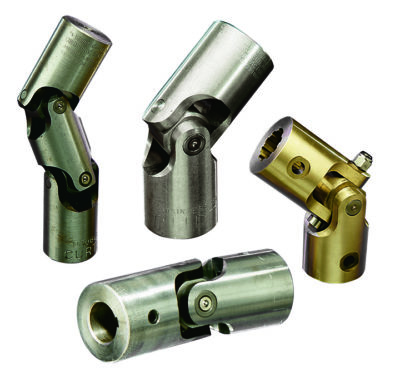
How does a universal joint accommodate misalignment between shafts?
A universal joint, also known as a U-joint, is designed to accommodate misalignment between shafts and allow for the transmission of rotational motion. Let’s explore how a universal joint achieves this:
A universal joint consists of a cross-shaped or H-shaped yoke with bearings at the ends of each arm. The yoke connects the input and output shafts, which are not in line with each other. The design of the universal joint enables it to flex and articulate, allowing for the accommodation of misalignment and changes in angles between the shafts.
When misalignment occurs between the input and output shafts, the universal joint allows for angular displacement. As the input shaft rotates, it causes the yoke to rotate along with it. Due to the perpendicular arrangement of the yoke arms, the output shaft connected to the other arm of the yoke experiences rotary motion at an angle to the input shaft.
The flexibility and articulation of the universal joint come from the bearings at the ends of the yoke arms. These bearings allow for smooth rotation and minimize friction between the yoke and the shafts. They are often enclosed within a housing or cross-shaped cap to provide protection and retain lubrication.
As the input shaft rotates and the yoke moves, the bearings within the universal joint allow for the necessary movement and adjustment. They enable the yoke to accommodate misalignment and changes in angles between the input and output shafts. The bearings allow the yoke to rotate freely and continuously, ensuring that torque can be transmitted smoothly between the shafts despite any misalignment.
By allowing angular displacement and articulation, the universal joint compensates for misalignment and ensures that the rotation of the input shaft is effectively transmitted to the output shaft. This flexibility is particularly important in applications where shafts are not perfectly aligned, such as in automotive drivelines or industrial machinery.
However, it’s important to note that universal joints do have limitations. They introduce a small amount of backlash or play, which can affect precision and accuracy in some applications. Additionally, at extreme angles, the operating angles of the universal joint may become limited, potentially causing increased wear and reducing its lifespan.
In summary, a universal joint accommodates misalignment between shafts by allowing angular displacement and articulation. The bearings within the universal joint enable the yoke to move and adjust, ensuring smooth and continuous rotation between the input and output shafts while compensating for their misalignment.


editor by CX 2023-11-27