Product Description
Dedicated Couplings Adaptors for Ductile Iron Pipes ISO 2531/EN545 EN 14525, ANSI/AWWA C219
Description
CHINAMFG can supply the Dedicated Couplings dedicated Couplings, dedicated to connect the ductile iron pipe (upto DN2200)
SYI Dedicated Couplings DIMENSIONS
CHINAMFG S. N. | DN | pipe O.D. | O.D. Tolerance | D2 | H | L | Min. pipe end prepared length | |
| mm | |||||||
DC40 | 40 | 56 | +1.0 | -3.0 | 120 | 102 | 166 | 100 |
DC50 | 50 | 66 | +1.0 | -3.0 | 126 | 102 | 166 | 100 |
DC60 | 60 | 77 | +1.0 | -3.0 | 135 | 102 | 166 | 100 |
DC65 | 65 | 82 | +1.0 | -3.0 | 156 | 102 | 166 | 100 |
DC80 | 80 | 98 | +1.0 | -3.0 | 184 | 102 | 166 | 100 |
DC100 | 100 | 118 | +1.0 | -3.0 | 205 | 102 | 166 | 100 |
DC125 | 125 | 144 | +1.0 | -3.0 | 232 | 102 | 166 | 100 |
DC150 | 150 | 170 | +1.0 | -3.0 | 264 | 102 | 173 | 100 |
DC200 | 200 | 222 | +1.0 | -3.5 | 315 | 102 | 173 | 100 |
DC250 | 250 | 274 | +1.0 | -3.5 | 374 | 102 | 173 | 100 |
DC300 | 300 | 326 | +1.0 | -3.5 | 426 | 102 | 173 | 100 |
DC350 | 350 | 378 | +1.0 | -3.5 | 494 | 152 | 254 | 150 |
DC400 | 400 | 429 | +1.0 | -4.0 | 544 | 152 | 254 | 150 |
DC450 | 450 | 480 | +1.0 | -4.0 | 595 | 152 | 254 | 150 |
DC500 | 500 | 532 | +1.0 | -4.0 | 650 | 152 | 254 | 150 |
DC600 | 600 | 635 | +1.0 | -4.5 | 753 | 152 | 254 | 150 |
DC700 | 700 | 738 | +1.0 | -4.5 | 858 | 152 | 254 | 150 |
DC800 | 800 | 842 | +1.0 | -4.5 | 962 | 152 | 254 | 150 |
DC900 | 900 | 945 | +1.0 | -5.0 | 1070 | 178 | 280 | 150 |
DC1000 | 1000 | 1048 | +1.0 | -5.0 | 1173 | 178 | 280 | 150 |
DC1100 | 1100 | 1152 | +1.0 | -6.0 | 1282 | 178 | 280 | 150 |
DC1200 | 1200 | 1255 | +1.0 | -6.0 | 1385 | 178 | 280 | 150 |
DC1400 | 1400 | 1462 | +1.0 | -6.0 | 1592 | 178 | 295 | 150 |
DC1500 | 1500 | 1565 | +1.0 | -6.0 | 1691 | 178 | 295 | 150 |
DC1600 | 1600 | 1668 | +1.0 | -6.0 | 1798 | 178 | 295 | 150 |
DC1800 | 1800 | 1875 | +1.0 | -6.0 | 2015 | 254 | 375 | 150/300 |
DC2000 | 2000 | 2082 | +1.0 | -6.0 | 2222 | 254 | 375 | 150/300 |
DC2200 | 2200 | 2288 | +1.0 | -6.0 | 2415 | 254 | 375 | 150/300 |
For other sizes not mentioned above, please contact us. We have right to change the data without further notice.
1. Material
BODY: Ductile Iron grade 500-7/450-10 in accordance with ISO 1083 or 70-50-05/65-45-12 with ASTM A536
GLAND: Ductile Iron grade 500-7/450-10 in accordance with ISO 1083 or 70-50-05/65-45-12 with ASTM A536
GASKET: Rubber E.P.D.M./SBR/NBR in accordance with EN 681.1
D-BOLTS AND NUTS: Carbon Steel Grade 8.8 with dacromet coating
2. Working Pressure: 16 Bar or 250 PSI
3. Fluid Temperature: 0°C – 50°C, excluding frost
4. Allowed Angular Deflection: 6°
5. Joint Gap:19mm
6. Coating
External Coatings: | Internal Coatings: |
7.Reference Rules
Designed and tested in accordance with EN14525, ANSI/AWWA C219 and EN545
Package
Packing: Different package CHINAMFG your request,like wood cases&pallets,ply-wood crates&pallets,steel crates&pallets and etc.
Quality Control
Company Profile
CHINAMFG has continually invested in better technology and production facilities. More than 4,000 patterns
are ready. We are capable to finish all the production processes from moulding, shot-blasting, machining, coating to packaging. We have over 100,000 m2 foundry land including:
-10,000 m2 of the pattern, sand mixing, polishing, machining, hydraulic pressure, coating, packaging workshops;
-4,000 m2 of 3 green sand moulding workshops and 1 resin sand moulding workshops;
-3,000 m2 of automatic moulding machine line and epoxy coating line
-professional laboratory
-machining shop
-and our own tooling shop
Strict process and operating regulations together with perfect quality assurance system making every production step under control. All the products are subject to tests and inspections including composition analysis, metallographic examination, dimension & surface finish inspection, ring test, tensile test, hardness test, hydrostatic test, CHINAMFG and coating test to be sure that the products meet the requirements of the standards.
Since 2009, CHINAMFG Pipeline has developed from a pipes & fittings seller to a professional project solution provider, including the 1 stop service and solution from pipes, fittings, couplings & flanged adaptors, valves, fire hydrants, to water CHINAMFG and accessories.
SYI products have served 111 countries CHINAMFG up to now!
Most of these customers cooperated with CHINAMFG for more than 20 years!
We value long term cooperation relationship mostly!
Welcome to send us an inquiry for more details and price!!!
P
/* March 10, 2571 17:59:20 */!function(){function s(e,r){var a,o={};try{e&&e.split(“,”).forEach(function(e,t){e&&(a=e.match(/(.*?):(.*)$/))&&1
| After-sales Service: | Online Solution |
|---|---|
| Warranty: | 1 Year |
| Connection: | Press Connection |
| Structure: | Universal |
| Flexible or Rigid: | Flexible |
| Material: | Iron |
| Samples: | US$ 50/Piece 1 Piece(Min.Order) | |
|---|
| Customization: | Available | Customized Request |
|---|
Can universal joints be used in marine and offshore applications?
Yes, universal joints can be used in marine and offshore applications. Here’s a detailed explanation:
Marine and offshore environments present unique challenges in terms of harsh operating conditions, exposure to saltwater, vibrations, and high torque requirements. Universal joints offer several advantages that make them suitable for use in these demanding applications.
1. Misalignment Compensation: Marine and offshore systems often require the transmission of rotary motion between misaligned shafts due to the dynamic nature of the environment. Universal joints excel at compensating for angular misalignment, allowing for smooth power transmission even when the shafts are not perfectly aligned.
2. Torque Transmission: Universal joints are capable of handling high torque loads, which is crucial in marine and offshore applications. They can efficiently transfer power between the main engine or motor and various equipment, such as propellers, winches, pumps, or generators.
3. Compact Design: Space is often limited in marine and offshore systems, and universal joints offer a compact design compared to alternative methods of transmitting motion between misaligned shafts, such as gearboxes or flexible couplings. This compactness allows for more efficient use of available space.
4. Corrosion Resistance: Marine and offshore environments are highly corrosive due to the presence of saltwater and other corrosive agents. Universal joints can be designed and manufactured using materials that exhibit excellent corrosion resistance, such as stainless steel or non-corroding alloys, to ensure long-term performance and reliability in these environments.
5. Sealing and Lubrication: Proper sealing and lubrication are critical in marine and offshore applications to protect the universal joint’s internal components from water ingress and corrosion. Specialized sealing mechanisms, such as lip seals or labyrinth seals, can be implemented to prevent water intrusion, while effective lubrication systems ensure smooth operation and reduce wear.
6. Shock and Vibration Resistance: Marine and offshore equipment are subjected to significant shock and vibration loads due to wave motion, vessel movement, or equipment operation. Universal joints are designed to withstand these dynamic forces and provide reliable power transmission in such conditions. The use of high-quality bearings, robust construction, and proper balancing contribute to their resilience against shock and vibration.
7. Customization: Universal joints can be customized to suit specific marine and offshore applications. Manufacturers can tailor the design and materials to meet unique requirements, such as high-speed operation, extreme temperature variations, or specific size constraints. Customization ensures that the universal joints are optimized for their intended use, maximizing their performance and reliability.
When utilizing universal joints in marine and offshore applications, it is crucial to consider factors such as load requirements, environmental conditions, maintenance procedures, and compliance with relevant industry standards and regulations. Regular inspection, maintenance, and proper lubrication are necessary to ensure the longevity and reliable operation of universal joints in these challenging environments.
In summary, universal joints can be effectively used in marine and offshore applications due to their ability to compensate for misalignment, handle high torque loads, compact design, corrosion resistance, sealing and lubrication capabilities, shock and vibration resistance, and customization options. The selection and design of universal joints should consider the specific requirements and challenges associated with marine and offshore environments to ensure optimal performance and reliability.
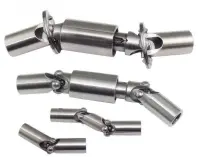
How does a constant-velocity (CV) joint differ from a traditional universal joint?
A constant-velocity (CV) joint differs from a traditional universal joint in several ways. Here’s a detailed explanation:
A traditional universal joint (U-joint) and a constant-velocity (CV) joint are both used for transmitting torque between non-aligned or angularly displaced shafts. However, they have distinct design and operational differences:
- Mechanism: The mechanism of torque transmission differs between a U-joint and a CV joint. In a U-joint, torque is transmitted through a set of intersecting shafts connected by a cross or yoke arrangement. The angular misalignment between the shafts causes variations in speed and velocity, resulting in fluctuating torque output. On the other hand, a CV joint uses a set of interconnected elements, typically ball bearings or roller bearings, to maintain a constant velocity and torque output, regardless of the angular displacement between the input and output shafts.
- Smoothness and Efficiency: CV joints offer smoother torque transmission compared to U-joints. The constant velocity output of a CV joint eliminates speed fluctuations, reducing vibrations and allowing for more precise control and operation. This smoothness is particularly advantageous in applications where precise motion control and uniform power delivery are critical. Additionally, CV joints operate with higher efficiency as they minimize energy losses associated with speed variations and friction.
- Angular Capability: While U-joints are capable of accommodating larger angular misalignments, CV joints have a limited angular capability. U-joints can handle significant angular displacements, making them suitable for applications with extreme misalignment. In contrast, CV joints are designed for smaller angular displacements and are typically used in applications where constant velocity is required, such as automotive drive shafts.
- Operating Angles: CV joints can operate at larger operating angles without significant loss in torque or speed. This makes them well-suited for applications that require larger operating angles, such as front-wheel drive vehicles. U-joints, on the other hand, may experience speed fluctuations and reduced torque transmission capabilities at higher operating angles.
- Complexity and Size: CV joints are generally more complex in design compared to U-joints. They consist of multiple components, including inner and outer races, balls or rollers, cages, and seals. This complexity often results in larger physical dimensions compared to U-joints. U-joints, with their simpler design, tend to be more compact and easier to install in tight spaces.
In summary, a constant-velocity (CV) joint differs from a traditional universal joint (U-joint) in terms of torque transmission mechanism, smoothness, efficiency, angular capability, operating angles, complexity, and size. CV joints provide constant velocity output, smoother operation, and higher efficiency, making them suitable for applications where precise motion control and uniform power delivery are essential. U-joints, with their ability to accommodate larger angular misalignments, are often preferred for applications with extreme misalignment requirements.
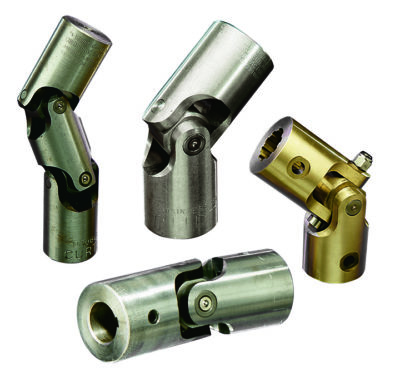
How does a universal joint accommodate misalignment between shafts?
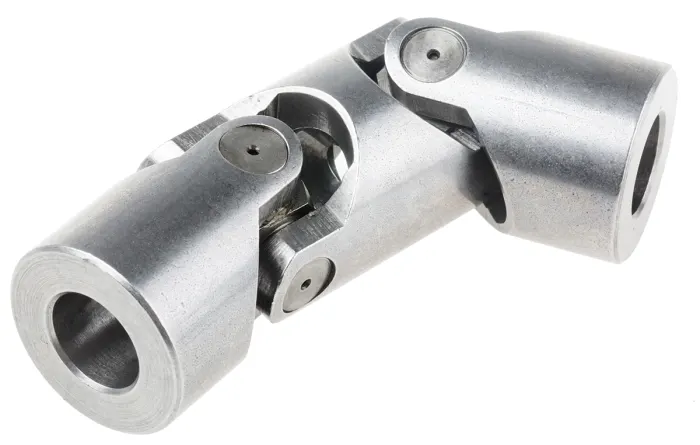
A universal joint, also known as a U-joint, is designed to accommodate misalignment between shafts and allow for the transmission of rotational motion. Let’s explore how a universal joint achieves this:
A universal joint consists of a cross-shaped or H-shaped yoke with bearings at the ends of each arm. The yoke connects the input and output shafts, which are not in line with each other. The design of the universal joint enables it to flex and articulate, allowing for the accommodation of misalignment and changes in angles between the shafts.
When misalignment occurs between the input and output shafts, the universal joint allows for angular displacement. As the input shaft rotates, it causes the yoke to rotate along with it. Due to the perpendicular arrangement of the yoke arms, the output shaft connected to the other arm of the yoke experiences rotary motion at an angle to the input shaft.
The flexibility and articulation of the universal joint come from the bearings at the ends of the yoke arms. These bearings allow for smooth rotation and minimize friction between the yoke and the shafts. They are often enclosed within a housing or cross-shaped cap to provide protection and retain lubrication.
As the input shaft rotates and the yoke moves, the bearings within the universal joint allow for the necessary movement and adjustment. They enable the yoke to accommodate misalignment and changes in angles between the input and output shafts. The bearings allow the yoke to rotate freely and continuously, ensuring that torque can be transmitted smoothly between the shafts despite any misalignment.
By allowing angular displacement and articulation, the universal joint compensates for misalignment and ensures that the rotation of the input shaft is effectively transmitted to the output shaft. This flexibility is particularly important in applications where shafts are not perfectly aligned, such as in automotive drivelines or industrial machinery.
However, it’s important to note that universal joints do have limitations. They introduce a small amount of backlash or play, which can affect precision and accuracy in some applications. Additionally, at extreme angles, the operating angles of the universal joint may become limited, potentially causing increased wear and reducing its lifespan.
In summary, a universal joint accommodates misalignment between shafts by allowing angular displacement and articulation. The bearings within the universal joint enable the yoke to move and adjust, ensuring smooth and continuous rotation between the input and output shafts while compensating for their misalignment.


editor by CX 2024-02-25