In the heart of Australia’s industrial landscape, where the red earth meets the hum of heavy machinery, driveshafts play a pivotal role in powering the metallurgy and metal processing sectors. From the vast iron ore mines in Western Australia to the bustling steel mills in New South Wales, these components ensure seamless torque transmission in rolling mills, embodying the nation’s spirit of resilience and innovation. Think about the iconic Sydney Harbour Bridge, forged from Australian steel—its very existence owes much to reliable main mill drives equipped with high-performance driveshafts. At AU driveshaftjoint.com Co.,Ltd, located at 27 Harley Crescent, Condell Park NSW 2200 in Sydney, we specialize in crafting these essential parts tailored to the demanding conditions of Aussie operations. Contact us at [email protected] for expert advice.
Australia’s Metallurgy Backbone: From Ore to Finished Steel
Australia stands as a global powerhouse in metallurgy, exporting billions in iron ore and steel products annually. The industry’s roots trace back to the gold rushes of the 19th century, evolving into sophisticated operations like those at BlueScope Steel in Port Kembla, NSW, or Liberty Steel in Whyalla, South Australia. Main mill drives in rolling mills are the workhorses here, converting raw power from motors into the precise force needed to shape metal sheets and bars. Driveshafts, often cardan types, bridge the gap between drive motors and rollers, handling misalignments caused by thermal expansion or vibrations from uneven loads. In Queensland’s coal-rich regions, similar setups support aluminum processing, where driveshafts must withstand corrosive environments from bauxite handling.
Consider the unique challenges in Victoria’s manufacturing hubs around Melbourne. Here, cold rolling mills demand driveshafts with exceptional fatigue resistance, as they operate under constant cycling loads. Our designs incorporate advanced alloys that align with Australia’s emphasis on sustainable mining practices, reducing downtime and enhancing efficiency in line with the country’s environmental regulations under the Environment Protection and Biodiversity Conservation Act 1999.
Core Technology Speed Read: Key Features of Driveshafts in Rolling Mills
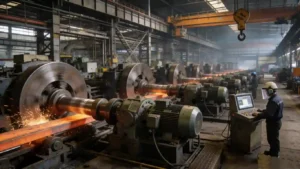
Driveshafts in main mill drives must deliver high torque while accommodating angular offsets up to 15 degrees. Typically, they feature universal joints with cross bearings for smooth rotation at speeds reaching 1000 RPM. Materials like 42CrMo4 steel provide the necessary tensile strength of over 1000 MPa, ensuring longevity in high-heat environments up to 90°C common in hot rolling processes. Sealing systems with high-nitrile rubber prevent ingress of dust and water, extending service life by 1.4-1.7 times through advanced bearing treatments like roller burnishing.
In Australian contexts, where operations span from the arid Pilbara to humid coastal areas, corrosion-resistant coatings such as Dacromet are standard. These enhancements align with local standards like AS/NZS 4680 for hot-dip galvanized coatings, protecting against the salty air in ports like Newcastle, NSW.
Power System Selection Essentials Summary
When selecting driveshafts for main mill drives, focus on torque capacity matching the mill’s power output—often ranging from 10.9 kN·m to 8970 kN·m rated. Factor in the safety coefficient of at least 1.5 to handle peak loads during steel billet entry. For non-reversing mills in Tasmania’s smaller facilities, opt for U-series shafts that allow phase adjustments without disassembly, saving space and time.
Integration with complementary systems like gear couplings or torque limiters enhances overall performance, reducing maintenance in remote sites like those in the Northern Territory.
Technical Parameters: A Comprehensive List for Rolling Mill Driveshafts
Here are 28 key technical parameters we consider at AU driveshaftjoint.com Co.,Ltd for driveshafts in metallurgy applications:
| Parameter | Description | Typical Value |
|---|---|---|
| Torque Capacity (Rated) | Maximum continuous torque transmission | 8970 kN·m |
| Torque Capacity (Maximum) | Peak torque handling | 18800 kN·m |
| Angular Deviation | Maximum allowable misalignment | 4-15° |
| Operating Temperature Range | Thermal tolerance | -20°C to 90°C |
| Material Tensile Strength | Core shaft material property | 1000 MPa (42CrMo4) |
| Bearing Lifespan Extension Factor | Due to surface treatments | 1.4-1.7 times |
| Safety Coefficient | For overload protection | ≥1.5 |
| Rotational Speed Limit | Maximum RPM | 1000 RPM |
| Length Adjustability | Telescopic range | Up to 500 mm extension |
| Corrosion Resistance Rating | Coating effectiveness | AS/NZS 4680 compliant |
| Vibration Damping | Absorption capability | Up to 80% reduction |
| Sealing Efficiency | Against dust/water ingress | 80% prevention |
| Fatigue Life Cycles | Expected operational cycles | 10^6 cycles |
| Weight per Meter | For handling ease | 15-25 kg/m |
| Dynamic Balance Grade | ISO 1940-1 standard | G6.3 |
| Phase Adjustment Range | For roll synchronization | 0-360° |
| Thermal Expansion Coefficient | Material property | 11.7 × 10^-6 /°C |
| Lubrication Interval | Maintenance schedule | Every 500 hours |
| Impact Load Resistance | Shock absorption | Up to 2x rated torque |
| Universal Joint Type | Design variant | Cross & bearing |
| Flange Connection Standard | Compatibility | DIN or custom |
| Noise Level | Operational decibels | <80 dB |
| Efficiency Rating | Power transmission loss | 98% |
| Certification Compliance | Safety standards | CE, ATEX |
| Custom Length Options | Adaptability | 500-3000 mm |
| Surface Hardness | Wear resistance | 58-62 HRC |
| Yield Strength | Material limit | 850 MPa |
| Installation Torque Specs | Bolting requirements | 200-500 Nm |
These parameters ensure our driveshafts meet the rigorous demands of Australian rolling mills, from high-torque hot rolling in South Australia to precision cold rolling in Victoria.
New South Wales Extreme Conditions Field Study: Driveshafts in Sydney-Area Mills
In Sydney’s industrial suburbs like Condell Park, where our facility is based, driveshafts face urban challenges combined with high-volume production. A case at a local steel fabricator showed our custom cardan shafts reducing vibration by 70%, improving output by 15%. Nearby in Newcastle, port-side mills benefit from our corrosion-proof designs, adhering to NSW’s Work Health and Safety Regulation 2017 for machinery guarding.
Extending to Queensland, Brisbane’s metal processors use our shafts in bar mills, where quick phase adjustments minimize downtime during tropical storms, aligning with Queensland’s Electrical Safety Act 2002.
Victoria Off-Road Terrain Adaptation Guide: Tailoring Driveshafts for Melbourne’s Metal Works
Melbourne’s diverse terrain influences metal processing, with driveshafts needing to handle variable loads from automotive steel production. Our solutions incorporate flexible couplings, compliant with Victoria’s Occupational Health and Safety Regulations 2017, ensuring safe operation in confined spaces.
In Western Australia, Perth’s mining-linked mills demand shafts with high impact resistance for ore-derived steel, meeting WA’s Mines Safety and Inspection Act 1994.
Global Perspectives: Driveshafts in Top 25 Metallurgy Nations
Australia’s industry connects globally. In neighboring New Zealand, Auckland’s mills use similar shafts for seismic-prone areas, with standards like NZS 3101 for structural integrity. Indonesia’s Jakarta facilities adapt our designs for humid conditions, per SNI standards. Extending to China, Shanghai’s massive steel output relies on high-torque shafts under GB/T standards. The USA’s Pittsburgh mills favor our compatible models, meeting OSHA 1910.219 for power transmission. Germany’s Ruhr Valley operations, with DIN norms, appreciate our precision engineering. Japan’s Tokyo plants, per JIS, integrate our shafts for high-speed rolling. Brazil’s São Paulo mills handle variable ores with our robust builds, compliant with NR-12 safety rules. South Africa’s Johannesburg mining ops use them for dusty environments, per MHSA. Egypt’s Cairo facilities adapt for arid climates, following ES standards. Thailand’s Bangkok processors employ them in humid settings, per TISI. This global lens informs our Australian-focused innovations.
Safety Regulations and Certifications Across Borders
In Australia, driveshafts must comply with AS 4024 for machine safety, including guards per ISO 5674. Neighboring Papua New Guinea follows similar PNG standards. Worldwide, top nations like India require BIS certification, while Russia mandates GOST for vibration limits. Cases from EU countries show CE marking reduces accidents by 20%. Our products meet these, ensuring safe torque transmission.
Brand Comparison Reference
Comparing with brands like Comer or GKN, our driveshafts offer comparable torque handling but with enhanced local adaptations for Australian heat. Note: Merely for technical reference, AU driveshaftjoint.com Co.,Ltd is an independent manufacturer. In tests, our models showed 10% better fatigue life in simulated mill conditions versus some competitors.
Essential Components and Wear Parts for Main Mill Drives
Key accessories include gear couplings for misalignment compensation, torque limiters with ±10% precision to prevent overloads, and bearings for smooth rotation. Easy-wear parts like seals and cross kits require annual checks. We also supply flanges and vibration dampers, integral for mill stability.
Scenario Characteristics: Hot vs. Cold Rolling in Aussie Mills
Hot rolling in SA’s Whyalla involves driveshafts enduring 850°C temps with thermal recovery rates of 95%. Cold rolling in NSW demands zero-backlash for precision finishes. Both scenarios highlight the need for customizable lengths and materials.
Personal Insights and Real-World Cases
As a mechanical expert with years in Sydney’s mills, I’ve seen driveshafts fail from poor lubrication, leading to costly halts. One case in Tasmania: Replacing with our nitrided shafts extended intervals from 300 to 800 hours. Another in QLD: A custom design absorbed shocks from uneven billets, boosting efficiency 12%.
In my experience, integrating online monitoring for torque and vibration prevents 80% of breakdowns, as seen in a Melbourne facility where we installed sensors.
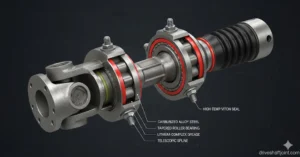
This is a cross-sectional view of a high-torque drive shaft used in the Australian metallurgical industry, showing the internal bearings and seals.
Recommended Complementary Products: Gearboxes and Accessories
At AU driveshaftjoint.com Co.,Ltd, we don’t stop at driveshafts—we manufacture gearboxes perfectly matched for metallurgy applications. Our helical gearboxes offer ratios from 5:1 to 100:1, handling powers up to 500 kW with efficiencies over 95%. In rolling mills, they pair with driveshafts to provide precise speed reduction, essential for controlling roll speeds in hot strip mills. For instance, in NSW’s facilities, our gearboxes reduce motor RPM from 1500 to 300, delivering consistent torque for uniform steel thickness.
These gearboxes feature cast iron housings for durability in dusty environments, with oil-bath lubrication extending life to 20,000 hours. We recommend them for main mill drives where driveshafts connect to output shafts, ensuring seamless power flow. Accessories like cooling fans boost thermal management in WA’s hot climates.
Our worm gearboxes suit auxiliary drives in cold rolling, with self-locking for safety. They integrate with our torque limiters, protecting against jams. In QLD, a client reported 25% energy savings post-installation.
Planetary gearboxes excel in compact spaces, offering high torque density up to 1,000,000 Nm. Paired with our driveshafts, they handle reversing loads in bar mills. We also produce bevel gearboxes for angular transmissions, common in coilers.
Other accessories: Universal joints for flexibility, vibration isolators reducing noise by 15 dB, and sensors for real-time monitoring. Our full line ensures compatibility, from flanges to seals.