PTO Shaft for Square Balers
Telescoping PTO drive shafts engineered specifically for the shock-load environment of small and large square balers. Knotter-mechanism torque spikes, slug feeding, and crop-induced stall events demand a driveline rated well beyond continuous-duty figures — our shafts deliver peak torque up to 3,700 Nm with integrated friction clutch protection that prevents gearbox damage in every overload event.
Product Overview
What Is a PTO Shaft
for Square Balers?
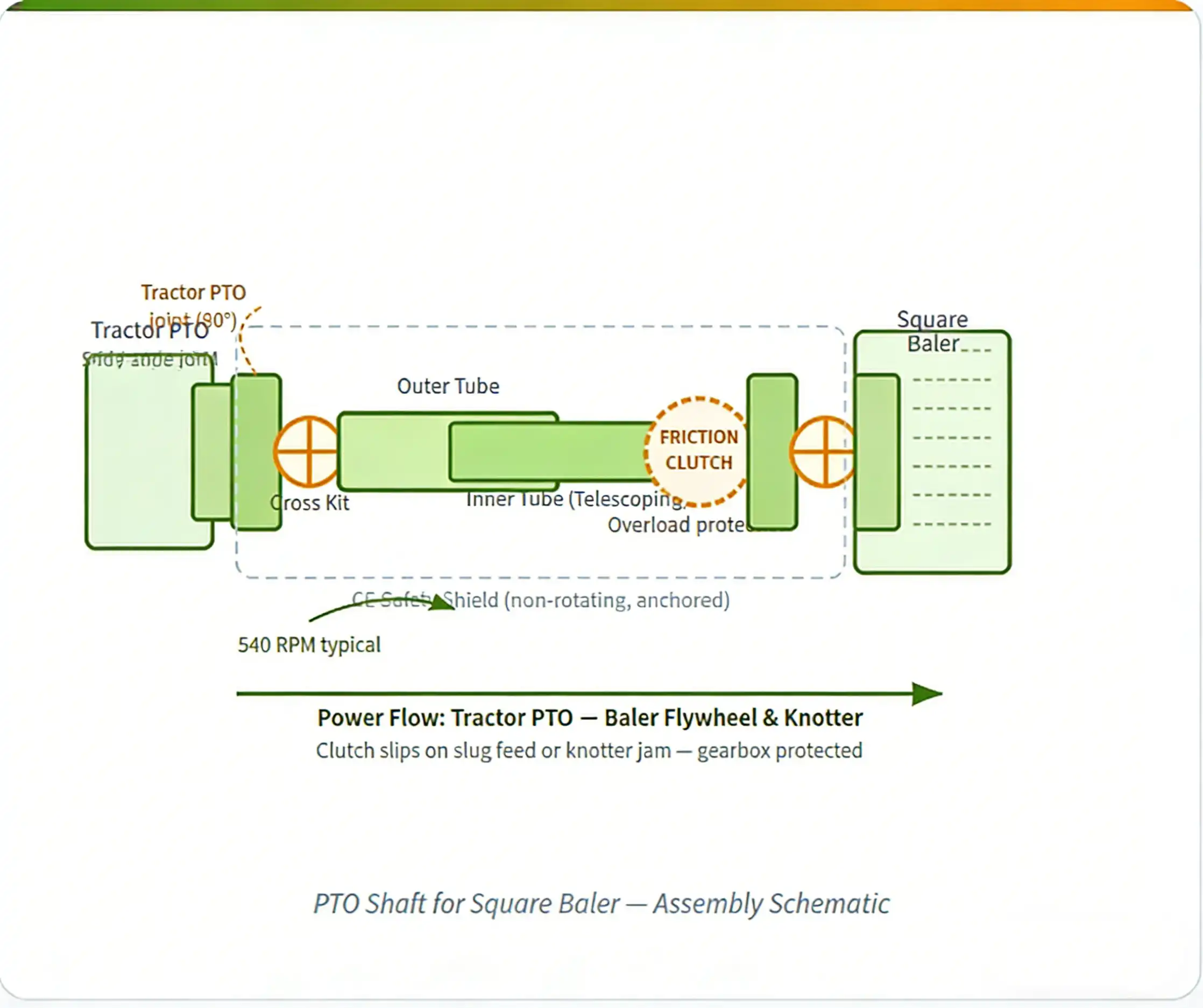
A PTO shaft for square balers is a telescoping mechanical driveline that connects a tractor’s Power Take-Off output to the input gearbox of a small or large square baler. It transmits rotational power at 540 or 1000 RPM to drive the baler’s flywheel, plunger, and knotter mechanisms — the three mechanical systems that pick up, compress, and tie each completed bale.
Unlike most PTO applications that impose relatively steady-state torque loads, square balers create highly cyclical, unpredictable shock loads. Each plunger stroke compresses a new slice of crop material — and if that slice is larger than expected (a “slug”), heavier crop species, or partially wet, the torque demand can spike to 3–6× the continuous running load within a fraction of a second. A PTO shaft without proper shock-load rating and friction clutch protection will fail — and the failure typically propagates to the tractor’s PTO gearbox, turning a $200–$600 shaft replacement into a $3,000–$8,000 gearbox repair.
driveshaftjoint.com supplies square baler PTO shafts across three tube-profile families — G Series (round spline), S Series (star profile), and L Series (lemon/tri-lobe) — with grades covering 15 kW to 119 kW at 540 RPM and peak torque ratings up to 3,700 Nm. Every unit ships with a calibrated friction clutch and CE-compliant safety shield as standard.
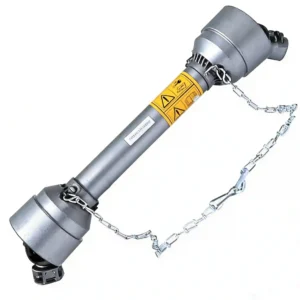
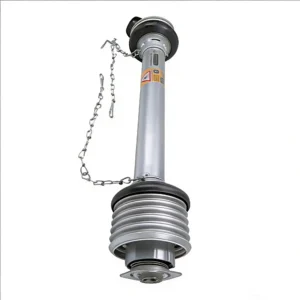
Square Baler PTO Shaft Display

Mechanics
How a Square Baler PTO Shaft Works
Four simultaneous mechanical functions keep the baler running through every field condition. A failure in any one of them stops the baler — and potentially damages the tractor.
Flywheel Drive
The PTO shaft spins the baler’s flywheel at 540 or 1000 RPM. The flywheel stores rotational energy that the plunger draws from on each compression stroke. Without consistent shaft rotation, flywheel speed drops and bale density becomes uneven.
Knotter Mechanism Drive
The knotter ties twine around each completed bale. It engages once per bale cycle, creating a brief but intense torque surge as needles arc through the dense bale chamber. Knotter-related jams are the primary cause of torque spikes that destroy standard PTO shafts.
Slug Absorption
When crop windrows are uneven, heavy patches enter the pickup faster than the baler can process them — a “slug.” The friction clutch in the PTO shaft absorbs the resulting torque spike before it reaches the gearbox. Without a clutch, a single slug event can shear shaft components or crack the gearbox housing.
Length Compensation
As the tractor turns at the headland, the distance between tractor PTO and baler input changes continuously. The telescoping inner/outer tube compensates for this — extending and compressing without transmitting axial force to the baler’s input shaft, which would cause premature bearing failure inside the gearbox.
The Real Cost of an Unprotected Square Baler Driveline
A PTO shaft without a correctly calibrated friction clutch transfers every slug, knotter jam, and crop plug directly to the tractor’s PTO gearbox. Field data from baler service workshops consistently shows that 70–80% of PTO gearbox failures on square balers are attributable to driveline shock loads — not to normal wear. Replacing a square baler PTO gearbox costs $3,000–$8,000 in parts and labour, plus the lost productivity of a baler sitting idle during peak hay season. A correctly specified friction clutch PTO shaft — which costs $200–$800 — eliminates this failure mode entirely.
Common Questions —Feed Mixer PTO Shafts
Is a friction clutch really necessary for a flail shredder PTO shaft?
Yes — for flail shredder applications, a friction clutch is not optional. It is the only mechanical system capable of intercepting a rock-strike torque spike before it reaches the tractor’s PTO gearbox. A rock strike decelerates the flail rotor within 20–50 milliseconds. At 540 RPM, the PTO shaft rotates at 9 revolutions per second — there is no reaction time for the operator to disengage. The friction clutch slips automatically the instant the torque threshold is exceeded, absorbing the spike. Without it, the full force is transmitted through the gearbox. Replacing a tractor PTO gearbox runs $3,000–$9,000. A friction clutch PTO shaft costs $200–$600. The cost argument is straightforward.
Why does my flail shredder PTO shaft keep failing near the yoke?
Yoke-end failure on flail shredder PTO shafts is almost always caused by one of four issues.
- (1) Undersized shaft: the peak torque rating (MP) of the shaft is below the actual impact torques generated during rock strikes. Upgrade one grade.
- (2) Seized or overtightened friction clutch: a clutch that doesn’t slip passes 100% of every impact to the shaft tube and yoke weld zone. Replace the friction disc assembly and verify slip torque.
- (3) Shaft bottoming out: if the inner tube contacts the outer yoke during tight turns or implement drop, the weld zone absorbs axial impact. Verify compressed length clearance.
- (4) Incorrect shaft angle: if the PTO shaft angle exceeds the universal joint’s rated limit (35–45° for standard, 80° for wide-angle), the cross kit generates cyclic bending loads on the yoke — which concentrate stress at the tube-to-yoke weld. Switch to a wide-angle joint if your shaft angle exceeds 35°.
Do I need an overrunning clutch on my flail shredder?
An overrunning clutch is recommended for flail shredders where:
- (1) the rotor mass is above approximately 300 kg and has significant rotational inertia;
- (2) you disengage the PTO frequently during operation (headland turns, obstacle avoidance, sudden stops);
- or (3) you have had tractor gearbox issues that occurred during PTO disengagement rather than during rock strikes.
A friction clutch protects against overload in the drive direction. An overrunning clutch protects against back-drive from the implement’s coasting inertia after PTO disengagement. Some applications need both — contact us with your shredder model and rotor specification and we’ll confirm the correct clutch configuration.
How often should I grease a flail shredder PTO shaft?
Grease cross kits every 8 operating hours using NLGI #2 lithium-complex EP grease. Apply through each trunnion cap nipple until fresh grease purges from the bearing seal — this confirms the needle roller cavity is fully charged. Flail shredders operate in extremely dusty, chaff-heavy, abrasive environments.
Dust and crop debris contaminate grease faster than in clean conditions — the 8-hour interval is the maximum, not a target. For commercial operators running shredders daily, grease at the start of each shift. Replace cross kits when you detect any roughness, play, or resistance in the joint — these are leading indicators of bearing needle roller failure, which rapidly progresses to complete joint seizure under impact loading.