PTO Shaft for Feed Mixers
What Is a PTO Shaft
for Feed Mixers?
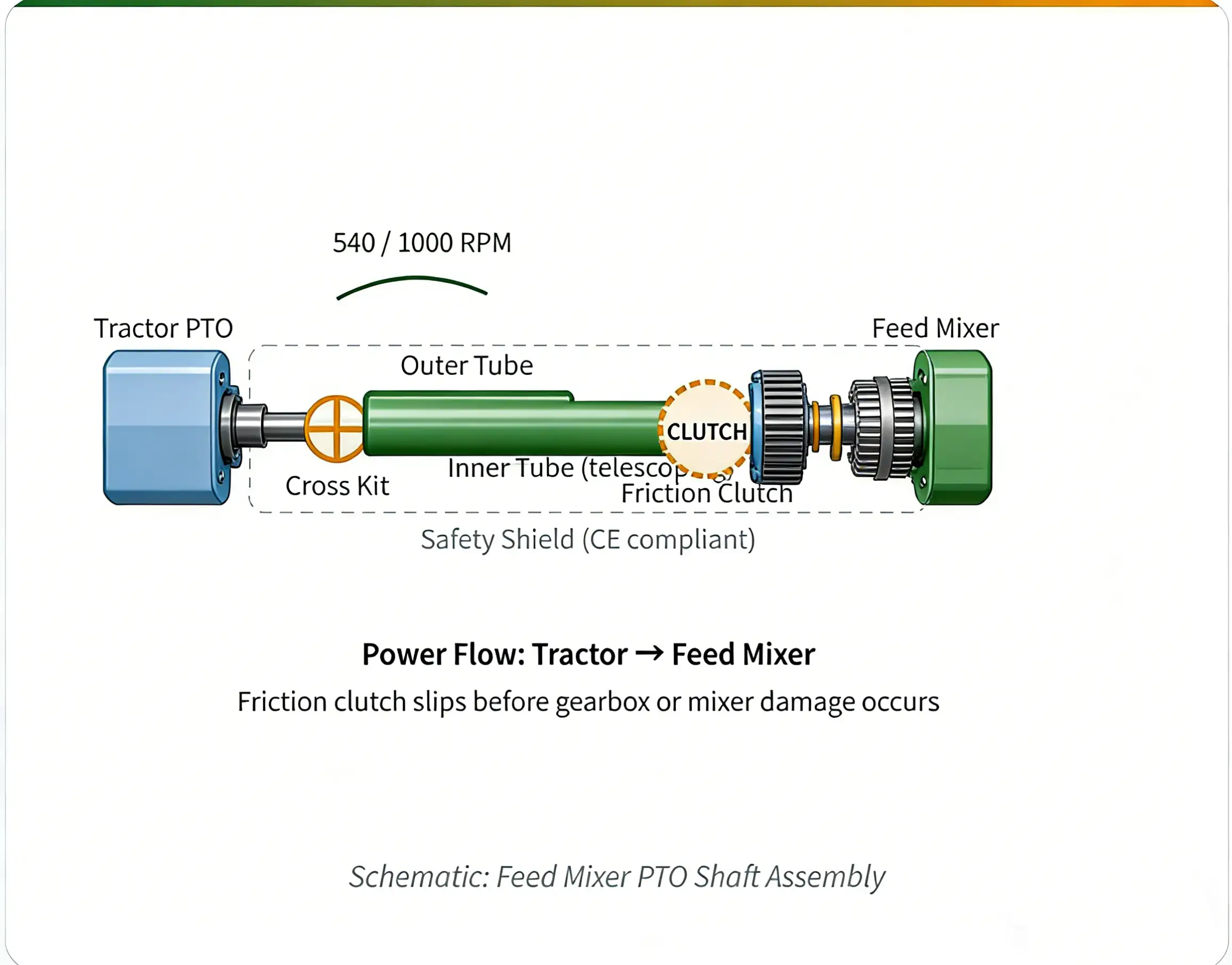
A PTO shaft for feed mixers (also called a feed mixer drive shaft or TMR mixer PTO shaft) is a telescoping mechanical driveline that transmits rotational power from a tractor’s Power Take-Off output directly to the input gearbox of a vertical or horizontal Total Mixed Ration (TMR) feed mixer.
The shaft bridges the distance between the tractor’s PTO stub shaft and the mixer’s input flange, converting engine torque into the high-torque, low-speed rotation that drives augers, paddles, and cutting knives inside the mixer drum. Without a correctly specified drive shaft, the tractor’s PTO gearbox absorbs every shock load generated by the mixing process — an expensive failure mode that can cost $4,000–$12,000 in gearbox repairs per incident.
Feed mixer PTO shafts differ from standard agricultural drivelines in three critical ways: higher peak torque ratings (frozen feed creates start-up spikes 3–5× the continuous running load), calibrated friction clutch protection to absorb those spikes before they reach the gearbox, and heavier-wall tube profiles that resist fatigue cracking under the constant compression-extension cycling of a three-point-mounted mixer.
Feed Mixer PTO Shafts Display
How It Works
Power Transmission:
Tractor PTO → Feed Mixer Auger
The PTO shaft performs four mechanical functions simultaneously. Understanding each one helps you spec the right shaft for your mixer’s specific load profile.
Torque Transmission
Converts tractor engine torque into the rotational force needed to turn mixer augers through dense, compacted, or partially frozen feed material. Rated continuously from 12 kW (L1/G2) up to 119 kW (G50) at 540 RPM.
Overload Absorption
The integrated friction clutch slips at a factory-set torque threshold when frozen feed, a foreign object, or motor stall creates a spike above the rated load. This prevents the $4,000–$12,000 tractor gearbox failures common with unprotected drivelines.
Length Compensation
The telescoping inner/outer tube allows the shaft to shorten and lengthen as the tractor turns or the mixer shifts position on the 3-point hitch. Without this, the shaft would either pull apart or bottom out — both causing immediate failure.
Angle Accommodation
Universal joints at each end allow the shaft to operate at an angle between the tractor PTO stub and the mixer input shaft — up to 80° on wide-angle variants — without binding, vibration, or uneven torque delivery that accelerates cross kit bearing wear.
Common Questions —Feed Mixer PTO Shafts
What PTO shaft series is best for a vertical auger TMR feed mixer?
For vertical auger TMR mixers, the S Series star-profile is the preferred choice. Vertical augers frequently reverse direction to dislodge impacted silage or straw — round-spline (G Series) tubes develop backlash under repeated torque reversals within one or two seasons, leading to the characteristic knocking sound that precedes tube failure. The S Series multi-lobe geometry eliminates this by transmitting torque through shape contact rather than spline teeth alone. For mixers between 35–79 kW PTO, specify S8 (2,250 Nm peak) or S42 (2,500 Nm peak). For compact tractors under 35 kW, the L5 lemon tube (1,050 Nm peak) provides the thicker wall needed to absorb frozen-feed start-up spikes.
Why does my feed mixer keep destroying PTO shafts in winter?
The most common cause is cold-start torque spikes. Frozen or very cold feed increases mixing resistance by 3–5× the normal running load. A PTO shaft rated for your tractor’s continuous PTO output at normal operating conditions may be significantly undersized for the momentary torque peak that occurs during cold-morning engagement.
The solution is either: (1) upgrade one grade higher than your calculated tractor PTO horsepower match, or (2) ensure the friction clutch is correctly specified — not a generic agricultural clutch, but one calibrated to the specific peak torque of your mixer series. If your current shaft has no friction clutch, or has a clutch that has been tightened beyond its rated setting, that is the primary failure cause.
Do I need an overrunning clutch or a friction clutch for my feed mixer?
Every 8 operating hours under continuous full-load conditions — which is the standard for daily dairy TMR operations. Use NLGI #2 lithium-complex grease (EP2 rated, temperature range −20°C to +120°C).
Apply through the grease nipple on each trunnion cap until fresh grease purges from the bearing seal, confirming the needle roller cavity is fully charged. Feed mixers typically run 1–3 hours per day in intensive operations — that equates to a greasing interval of every 3–8 days depending on your schedule. Extend this interval only with sealed, pre-greased cross kits specified for low-maintenance applications; contact us if this is a requirement.
How often should I grease feed mixer PTO shaft cross kits?
Every 8 operating hours</strong> under continuous full-load conditions — which is the standard for daily dairy TMR operations. Use NLGI #2 lithium-complex grease (EP2 rated, temperature range −20°C to +120°C).
Apply through the grease nipple on each trunnion cap until fresh grease purges from the bearing seal, confirming the needle roller cavity is fully charged. Feed mixers typically run 1–3 hours per day in intensive operations — that equates to a greasing interval of every 3–8 days depending on your schedule. Extend this interval only with sealed, pre-greased cross kits specified for low-maintenance applications; contact us if this is a requirement.